
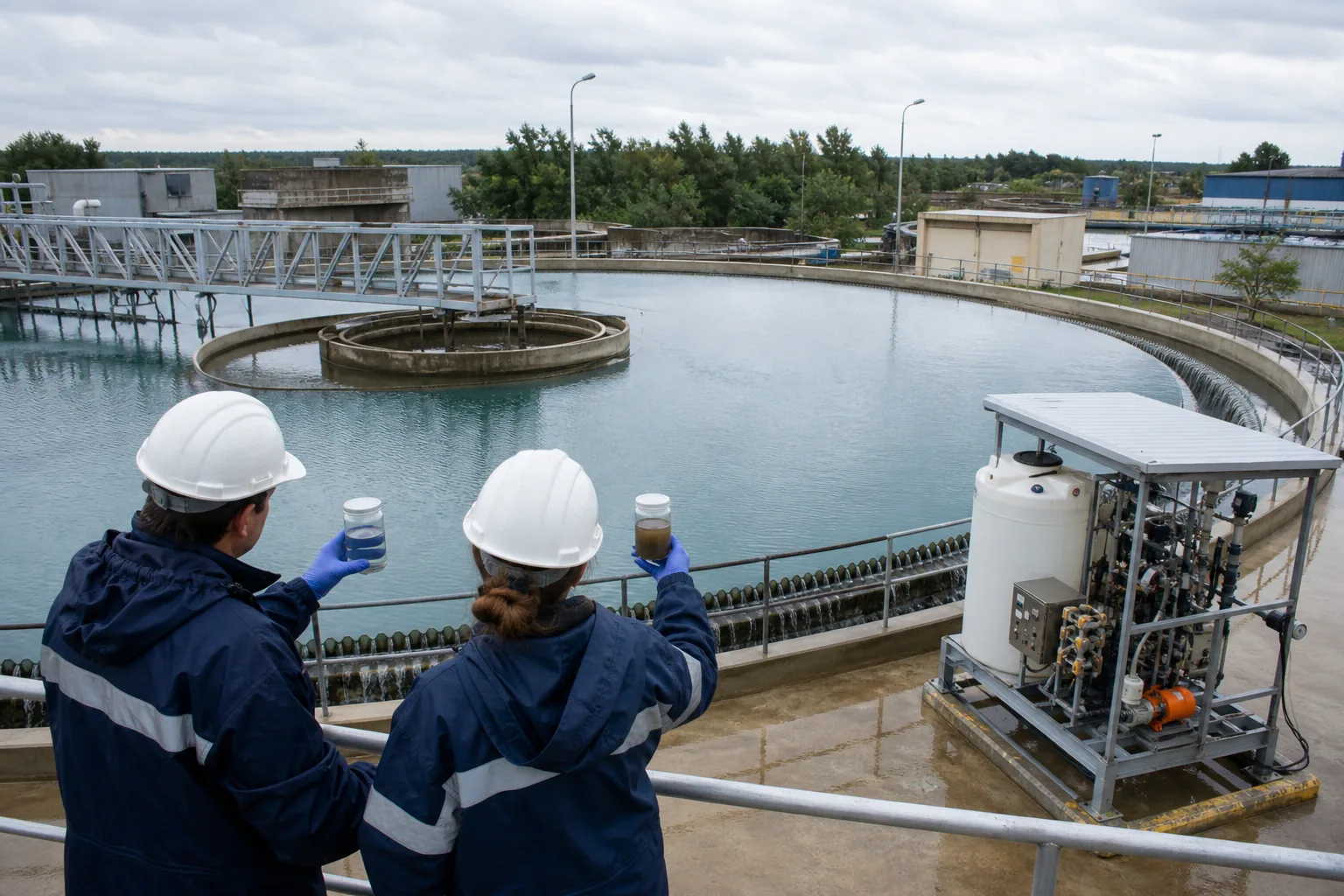
Define the separation route
A gravity clarifier rewards settling velocity and compact sludge; dissolved-air flotation rewards particle-bubble attachment and a stable float blanket. The same feed can therefore require different polymer charge, dose and contact history.
Record coagulant type, pH correction, rapid-mix point, flocculation time, hydraulic loading, recycle ratio and target effluent measurement.
Test rate and quality together
Use turbidity or suspended solids beside interface speed, float formation or sludge volume. A faster separation that releases fines may overload filters or recycle loops.
Introduce a controlled disturbance to see whether floc survives the real transfer path. Keep polymer solution age and dilution consistent across the comparison.
Scale through the actual equipment
Set the plant trial around stable feed periods and bracket the expected dose. Adjust one variable at a time, allow the separator inventory to respond and retain the lag between dosing and outlet measurement.
Provide design flow, current chemistry, separator dimensions, target quality, sample destination and expected volume when requesting a grade and quotation.