
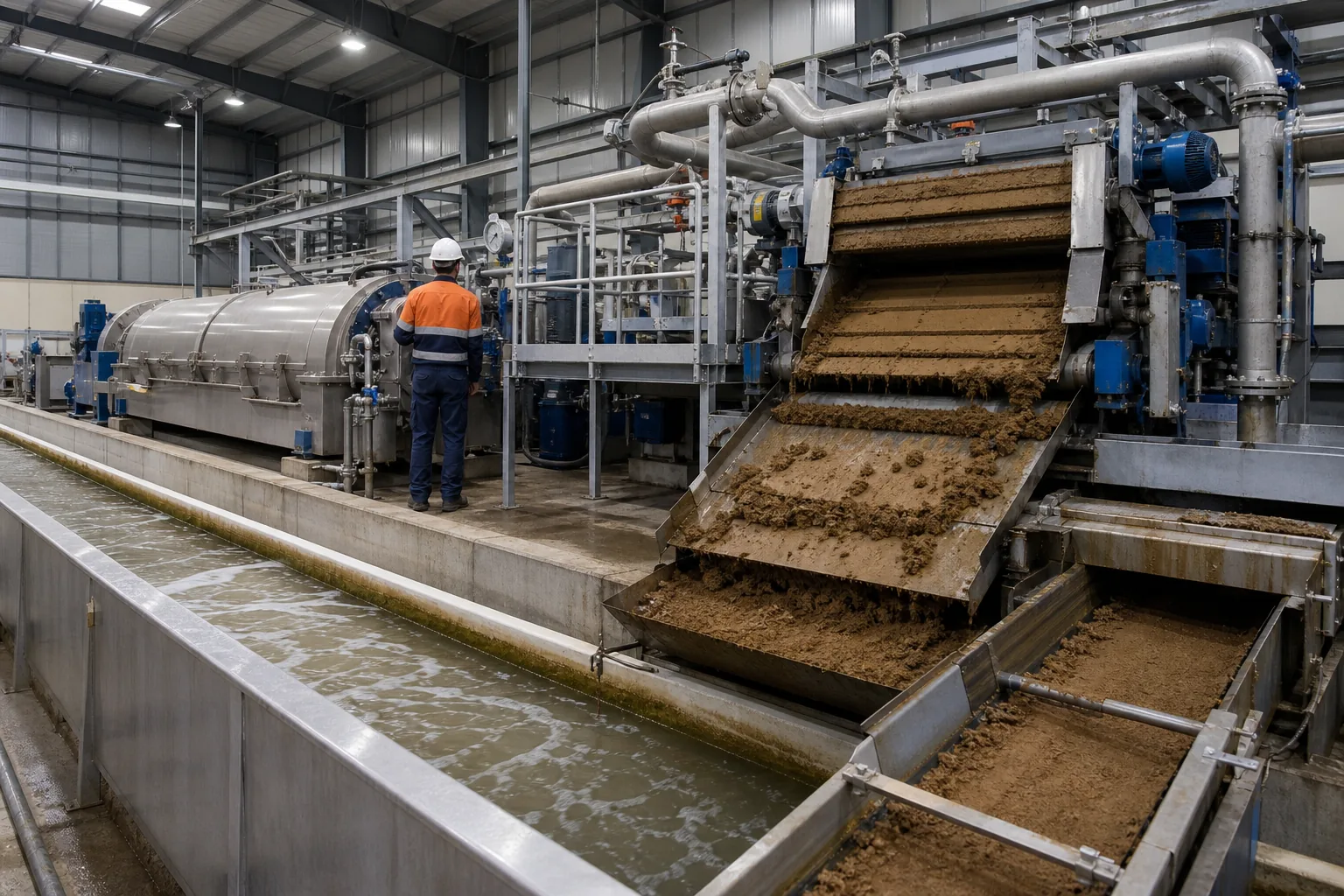
Where the cationic profile starts
Cationic polymer profiles are commonly screened where negatively charged biological or organic solids must be conditioned before centrifuges, belt presses or flotation. Charge density affects adsorption; molecular reach affects bridging and shear response.
Do not approve a grade from ionic label alone. Record sludge origin, solids concentration, pH, conductivity, upstream coagulant and the actual dewatering machine.
Build a charge-and-structure screen
Compare adjacent charge-density and molecular-profile candidates at equal active dose. Observe initial capture, floc size after controlled shear, free-water release and the point at which additional dose stops improving the separation.
A highly charged product can satisfy charge demand quickly yet produce a fragile or tight floc. A broader molecular window may perform differently through a feed pump or centrifuge zone.
Approve the equipment endpoint
For centrifuges, retain centrate suspended solids, torque, throughput and cake solids. For belt presses, retain drainage, belt release, wash-water demand and cake handling. For DAF, retain recycle pressure, float blanket and clarified effluent.
Send the selected sample code, preparation record and active-dose curve with the RFQ so the commercial grade remains traceable to the process evidence.