
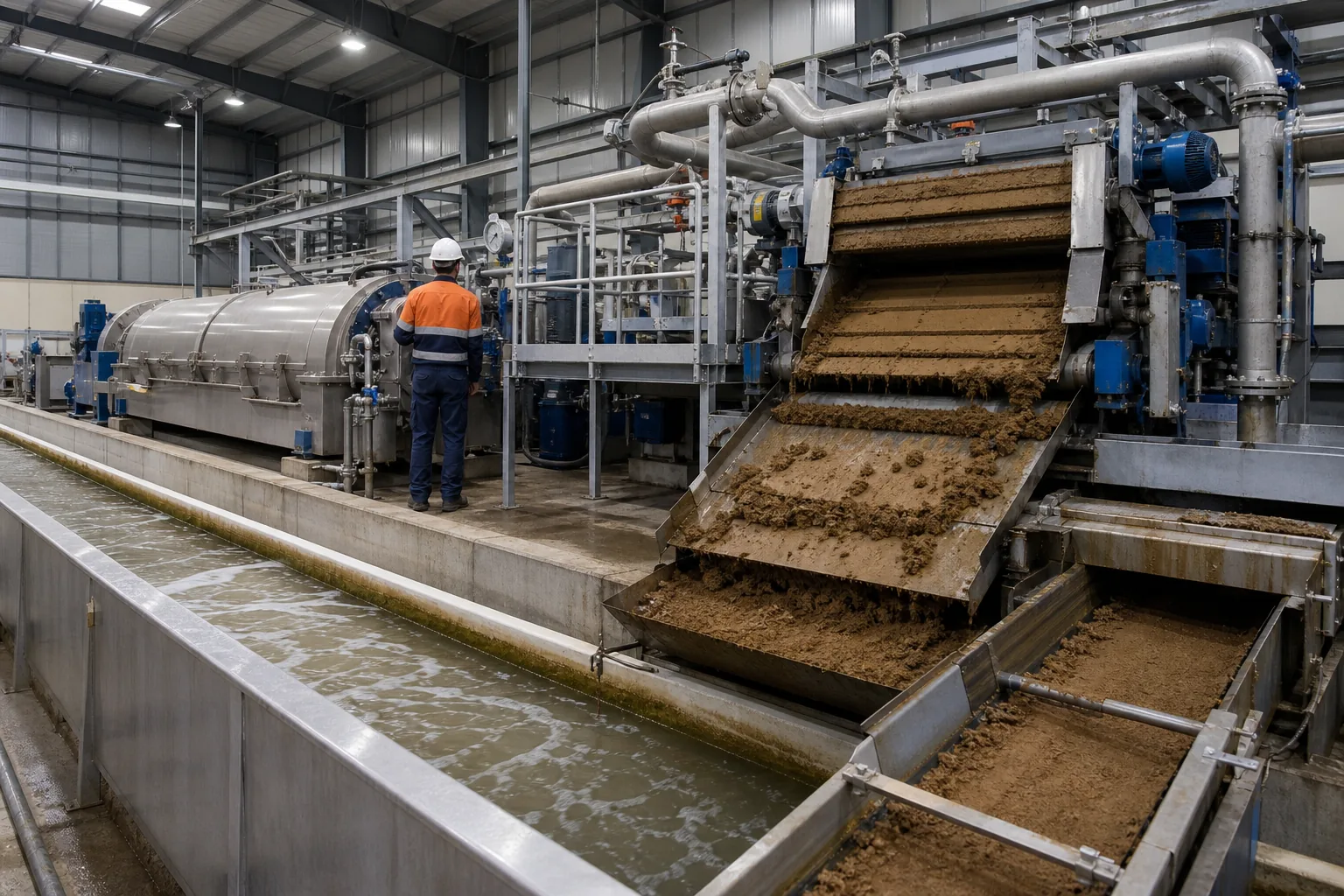
Establish the sludge baseline
Measure feed solids and record sludge source, blend ratio, age, temperature, pH, conductivity and upstream treatment. Capture current machine throughput, centrate or filtrate quality, cake solids and polymer consumption before changing product.
A trial without a stable baseline can confuse a feed shift with product performance.
Screen chemistry before machine time
Use bench drainage, shear and separation tests to narrow the candidate set. Compare cationic charge and molecular profiles at equal active dose and include the current product as a control.
The bench screen should identify a window, not declare the final winner. Centrifuge acceleration and belt mechanics cannot be reproduced fully in a jar.
Plan a centrifuge trial
Hold feed and mechanical settings stable long enough to compare centrate solids, torque, pond or differential settings, throughput and cake solids. Change one variable at a time and allow the machine inventory to respond.
Observe vibration, polymer solution flow and feed-zone behavior. A higher dose that cleans centrate but restricts throughput may not reduce total cost.
Plan a belt-press trial
Track gravity drainage, floc strength through distribution, filtrate quality, belt speed, pressure, cake release and wash-water demand. Inspect whether sticky polymer residue increases cleaning or blinds the belt.
Repeat during representative sludge, not only a low-load period. Normalize dose to dry solids.
Release a commercial grade
Retain approved sample and lot, exact make-down method, pump calibration, operating window and machine results. Compare delivered treatment cost per dry solids processed and disposal impact rather than bag price alone.
Attach expected consumption, packaging, documents and destination to the supplier RFQ so logistics match the technical decision.
Bracket feed variability before the trial
Review at least several normal operating periods to understand solids concentration, volatile fraction, blend ratio and temperature. Choose a trial window that contains representative sludge rather than the easiest shift. If feed changes, preserve samples and normalize polymer consumption so each product is compared on the same dry-solids basis.
Set stop conditions for unacceptable centrate, filtrate, torque, vibration, belt tracking or cake handling. Operational safety and discharge limits take priority over completing a candidate run.
Calculate the result across the whole machine
For each stable condition, reconcile neat polymer use, solution concentration, feed flow and dry solids. Pair cost with tonnes of dry solids processed, cake disposal, return-load impact, wash water and operator intervention. A small cake-solids gain can be valuable, but only if throughput and liquid quality remain acceptable.
Document the final mechanical settings beside the chosen dose. Without them, the product cannot be compared fairly on the next shift or after a machine adjustment.
Confirm repeatability before declaring a winner
Return the machine to the baseline product or repeat the leading candidate after other runs. This checks whether sludge drift, warming equipment or operator adjustment created the apparent improvement. Preserve feed samples from each period when laboratory comparison is practical.
A successful result should recur within the expected feed range and remain usable for the next operating team. Record the handover limits, dose adjustment logic and signs that require a new bench screen.