
Define the purchasing duty
White-water solids recovery is not the same duty as wastewater sludge dewatering or wet-end retention. A purchasing trial should state which fibers and fillers are recovered and where both recovered material and clarified water return.
Keep the proposed commercial product connected to the feed, preparation route and separator that will decide acceptance.
Identify the recovery loop
Record furnish and filler context, consistency, pH, conductivity and known dissolved additives. Identify saveall, clarification or DAF equipment rather than treating every paper-water loop as identical. Preserve feed changes across relevant production grades.
Use the adsorption and bridging explanation to frame candidate testing, not to assume a universal paper-mill charge.
Keep recovery quality visible
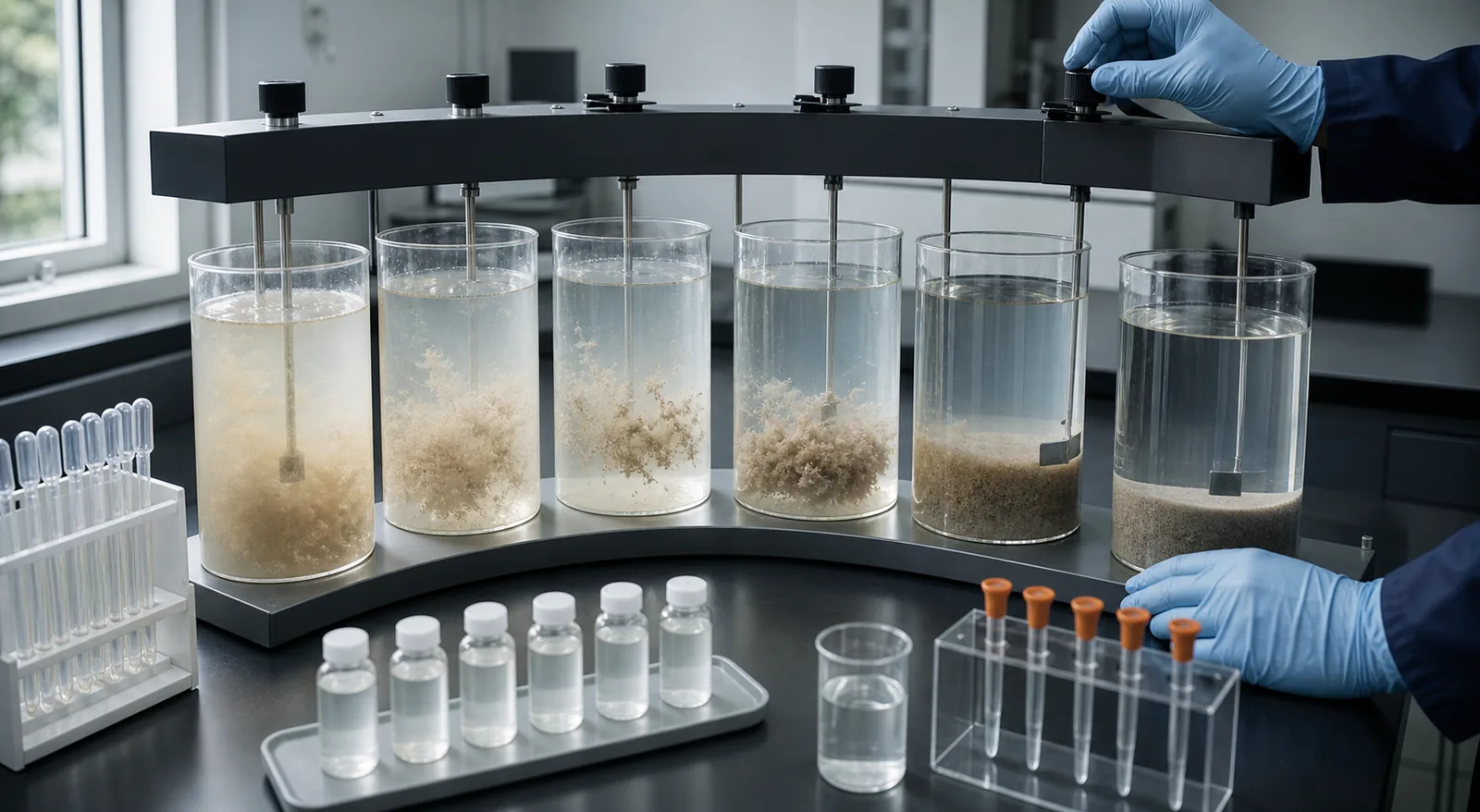
Compare capture with the quality and handling of recovered material and the return water. Fiber-rich visible floc can hide residual filler fines. Run controlled dose curves with consistent preparation and measure the parameter that limits reuse or downstream operation.
A laboratory capture advantage should not be converted into a machine-product quality claim without the mill qualification that supports it.
Confirm the actual separator
For flotation use the relevant air-contact and float-removal route; for gravity separation retain settling, clarity and withdrawal. The equipment comparison prevents one test method from standing in for both.
Record whether residual polymer or changed recovered solids need additional process confirmation before broad repeat supply.
Check an apparently favorable result
If a candidate recovers more visible fiber but changes the recycled stream in an untested way, keep the recovery result and the open compatibility question separate. Do not infer wet-end suitability or finished-paper approval from the separation result alone.
Record unresolved conditions separately from completed qualification. A proposed benefit is not a measured plant result.
Keep an acceptance record
Attach candidate code, sample lot, preparation, feed condition and measurement method to the purchase decision. Preserve failed points as well as the preferred condition so later supply can be reviewed against the actual evidence.
| Requirement | Evidence | Approval boundary |
|---|---|---|
| Loop | Defined recovery and return destinations | Product serves the intended stage |
| Recovery | Fibers and fine-solids measurements | Appearance does not hide losses |
| Compatibility | Relevant downstream confirmation | Purchase stays within tested use |
Request the right sample and quotation
Provide furnish or grade variation, fibers/fillers, current additives, separator and recovered-material destinations. State which process or product-quality checks remain to be completed.
Include quantity, destination and document needs in the sample and RFQ record. Review quality and supply controls with Gongyi Xinqi Polymer Co., Ltd.; confirm the offered grade and commercial terms before ordering.
Request a product and supply review
Send the feed, separator and intended purchase scope.