
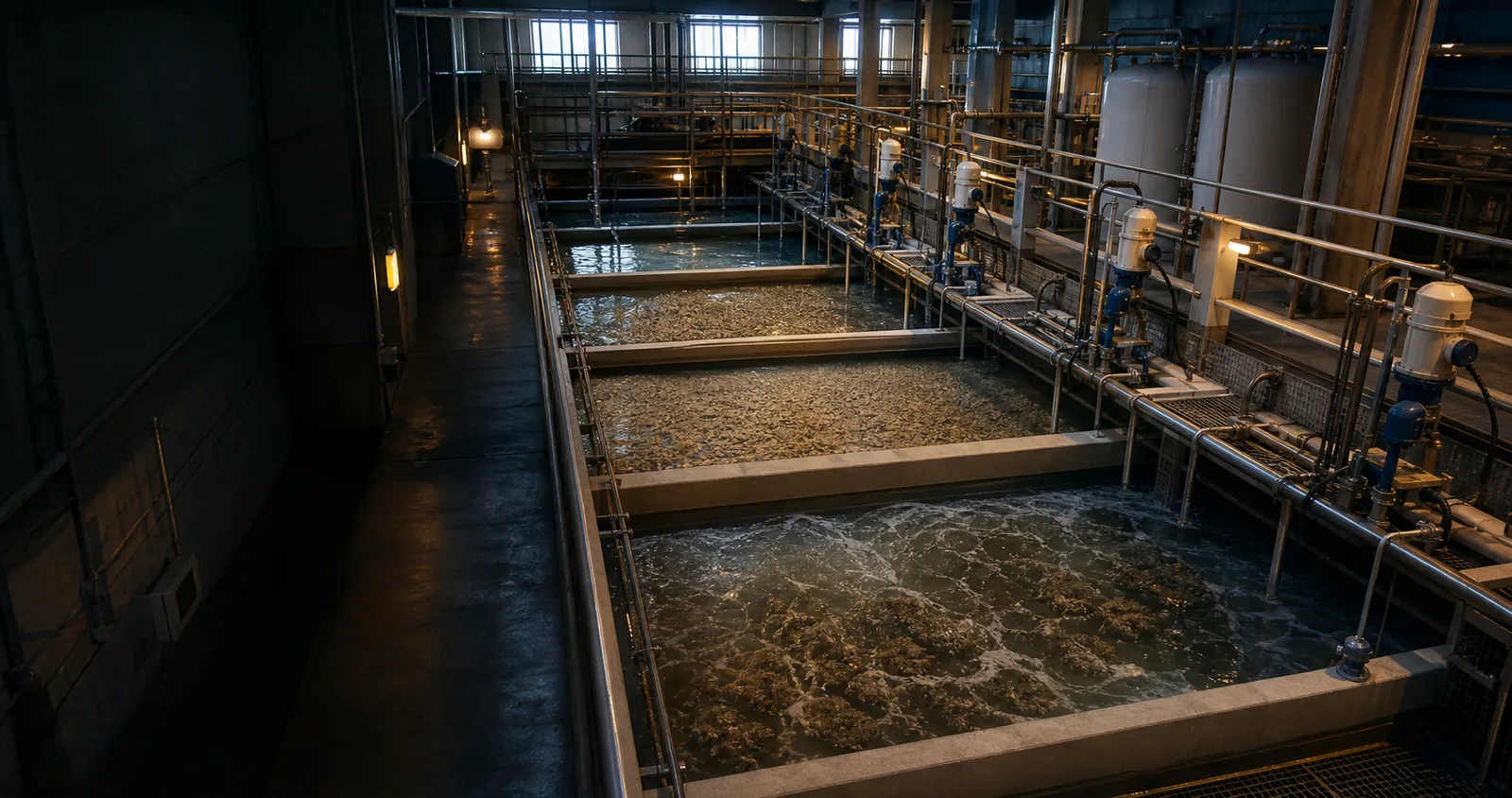
Separate coagulation from flocculation
Coagulation reduces the forces that keep small particles dispersed; flocculation gives destabilized material controlled contact and growth. A polyelectrolyte may contribute charge interaction, surface patching, molecular bridging or a combination, depending on its structure and the feed.
The terms are operationally linked but not interchangeable. Document the metal salt, pH correction or primary polymer already present before judging the secondary flocculant.
Adsorption needs accessible sites
Polymer must reach and adsorb on the suspended material. Dissolved salts, competing organics, surfactants and mineral reagents can alter the accessible surface. A product that works in fresh water may respond differently after recycle-water ions accumulate.
Test the actual process water and retain pH, conductivity and upstream treatment. An unexplained result often comes from a changed surface condition rather than a defective product.
Bridging needs molecular reach
A chain segment adsorbs to one particle while loops and tails extend into water and attach to another. Excessive dose can cover too much surface and reduce available bridging sites; excessive shear can break the formed structure faster than it recovers.
Compare growth under controlled low shear and add a repeatable high-shear interval that represents plant transfer. Observe whether clarity and separation recover after mixing stops.
Contact history shapes the result
Dry powder must disperse, hydrate and mature before dosing. At the application point, dilution, injection geometry, rapid distribution and gentle growth determine whether polymer contacts solids evenly. Undissolved fisheyes or concentrated slugs create misleading dose demand.
Map every pump, valve, elbow and chamber between injection and separation. A useful plant trial changes one part of this contact history at a time.
The separator defines success
Gravity settling, DAF, filtration, centrifuges and belt presses reward different floc properties. Pair a rate metric with a quality or solids metric: settling speed with overflow turbidity, drainage with filtrate solids, or centrifuge throughput with cake dryness.
Approve the product only when the measured endpoint remains stable across representative feed. Attractive floc in a beaker is evidence of aggregation, not final proof of process value.
Understand why more polymer can reduce capture
At low dose, too few chains or charged sites are available to connect the dispersed solids. Within the useful window, adsorption and bridging create particles large enough for the separator. Beyond that window, excessive surface coverage, charge reversal or unadsorbed polymer can reduce bridging, restabilize fines or change sludge handling.
The exact mechanism cannot be diagnosed from appearance alone. A blank and full active-dose curve, combined with supernatant or filtrate measurement, gives stronger evidence than comparing only two doses.
Connect molecular behavior to process residence
Floc formation continues through the available contact volume and can reverse under later shear. Short residence may leave adsorption incomplete; long uncontrolled mixing may break the floc. The useful product therefore depends on where solution is injected, how quickly it disperses and how long material travels before separation.
Measure the actual delay between polymer pump and outlet response during plant trials. This prevents premature dose changes and links laboratory mixing stages to the plant's hydraulic sequence.