
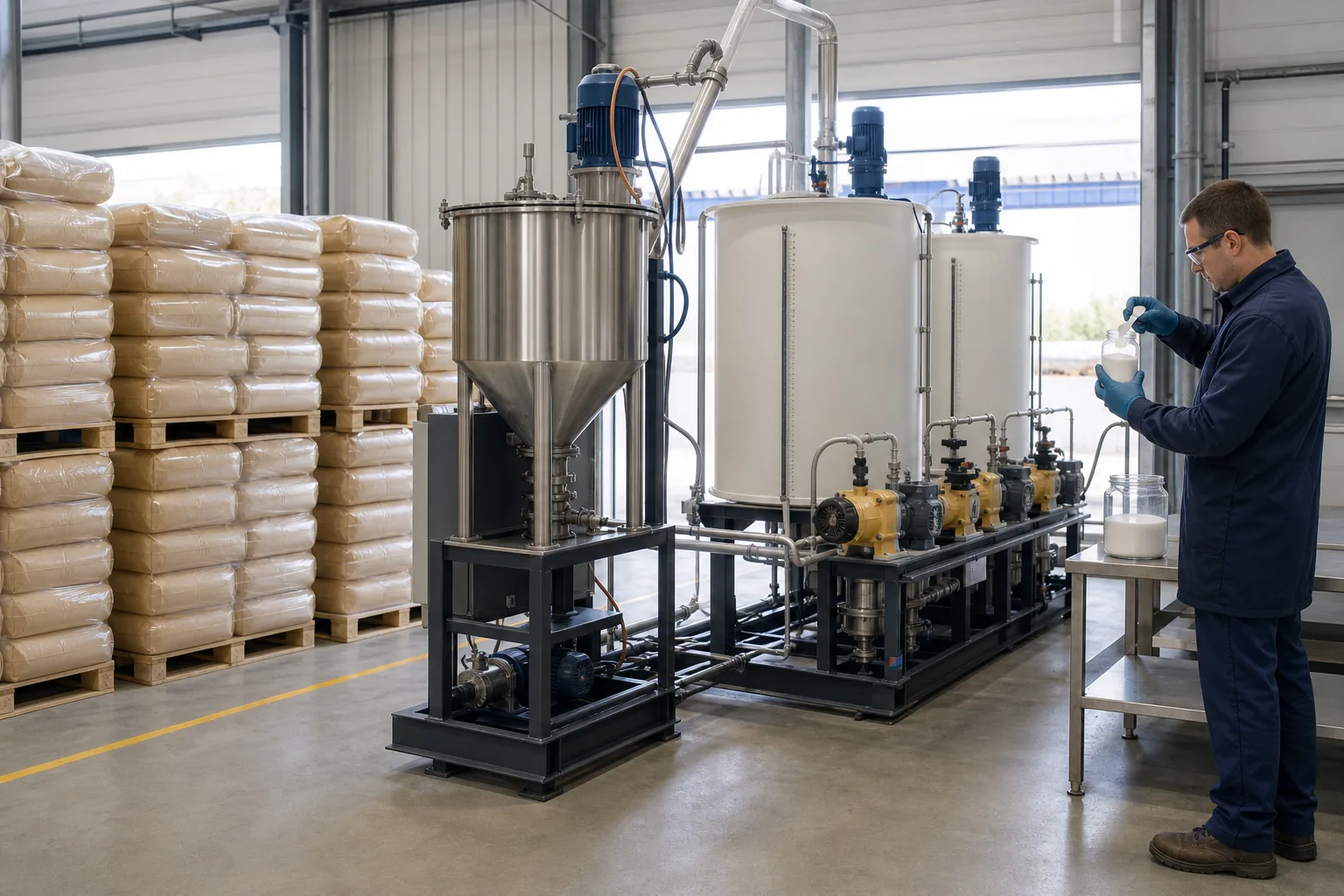
Start with suitable preparation water
Water temperature, hardness, salinity and contamination influence wetting and hydration. Use a clean tank and verify that residual cationic or anionic product will not contaminate the next batch. Never assume potable water and process water produce identical solution behavior.
Record the water source, temperature and batch volume. Review the product-specific technical and safety guidance before setting concentration or mixing conditions.
Induct powder without fisheyes
Create adequate water movement before adding powder. Feed it gradually across the wetting zone so individual particles contact water rather than forming a dry core inside a gelled shell. Avoid dumping bags directly into a tank.
Inspect the hopper, eductor and tank surface for deposits. A nominally complete batch can still contain undissolved material that blocks lines and makes dose response erratic.
Balance mixing and chain protection
Mixing must disperse and hydrate the powder, but excessive high shear can damage long polymer chains. Follow the supplier's product-specific procedure and keep impeller type, speed, batch volume and time on the preparation record.
After initial wetting, allow the specified maturation period. Do not use viscosity alone as proof of full hydration.
Dilute for distribution
A mature stock may need secondary dilution so it spreads across the feed before local overconcentration occurs. Introduce dilution water in a controlled line or mixer and verify actual solution flow at the application point.
Check pumps, valves and static mixers for shear, dead zones and contamination. Trace the route from make-down tank to separator.
Control age, storage and housekeeping
Mark batch time and use a defined solution-age window. Heat, prolonged storage and biological contamination can change performance. Keep dry bags sealed, protected from moisture and handled with dust and slip controls.
When troubleshooting, compare a fresh verified batch with the plant solution before changing grade or dose. Preparation faults can imitate weak product performance.
Verify the make-down system at operating flow
Batch volume, water pressure and powder feeder output determine whether the designed concentration is achieved. Time a known pump volume, reconcile powder consumption and inspect tank level changes. A controller setpoint is not proof of actual concentration when feeders bridge, eductors foul or water valves drift.
Sample mature solution from a representative point rather than the quiet tank surface. Note visual gels, undissolved particles and transfer-line deposits, then correct the mechanical cause before increasing process dose.
Manage changeover between charge families
Residual cationic and anionic products can form deposits or apparent gels when mixed. Plan separate tanks and lines where practical, or use a documented drain, rinse and verification procedure before changeover. Check low points, pump heads and calibration columns where concentrated solution remains.
Label the active product at storage, induction and dosing points. During a trial, isolate and identify each solution so an operational change cannot be mistaken for product chemistry.