
Define the purchasing duty
Changing product form is an installation and qualification decision, not just a different delivery package. A powder and an emulsion may require different preparation routes even when both are offered for the same separator.
Keep the proposed commercial product connected to the feed, preparation route and separator that will decide acceptance.
Define the offered formulation
Request family, code, product form, relevant composition or active reporting basis and SDS. Do not assume that the liquid offer is an emulsion rather than a solution or dispersion. Keep any emulsifier or carrier considerations within the offered product documentation and site assessment.
Availability and suitability of an alternative form must be confirmed; the product-family name alone is not an offer.
Evaluate preparation requirements
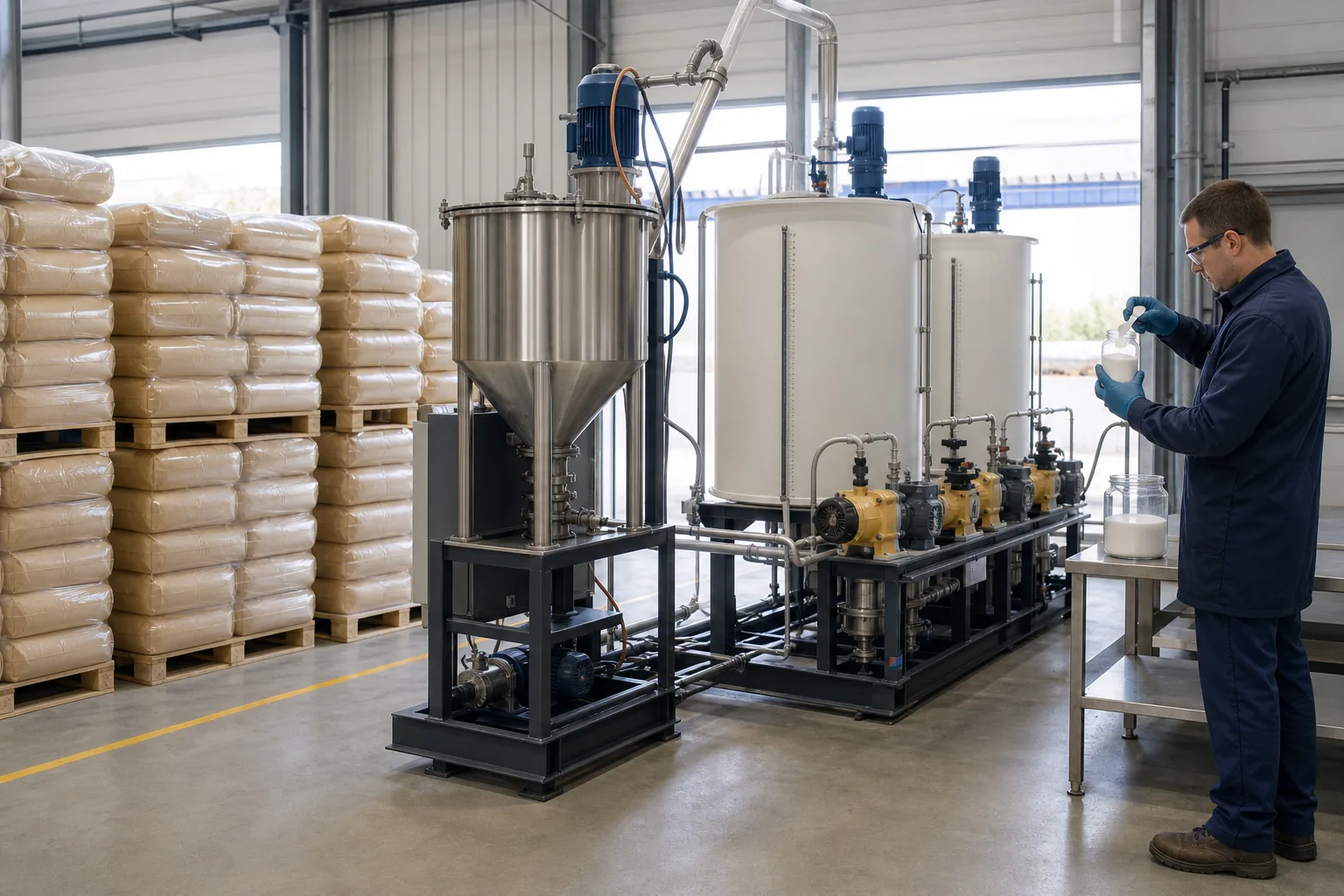
Powder induction and hydration are not interchangeable with grade-specific emulsion activation. Record installed feeders, wetting, activation water, residence, transfer and injection. Use the powder preparation record as the incumbent baseline rather than imposing it as the alternative recipe.
Include changes to pumps, water demand and operating procedures in the purchase scope before calling a candidate a direct replacement.
Compare qualified delivered use
Use one mass convention and consistent feed and endpoint measurements. Include freight, storage, handling, preparation losses and installation changes. The dose-curve comparison should preserve the supplier preparation requirements while keeping the resulting active-dose basis explicit.
A smaller dosing-pump volume or a lower price per supplied kilogram is not by itself evidence of a cheaper separation result.
Check an apparently favorable result
If a form conversion needs equipment that is not installed, keep the proposed benefit conditional on that conversion. Do not approve routine supply from a laboratory batch prepared under conditions the plant cannot reproduce at peak demand.
Record unresolved conditions separately from completed qualification. A proposed benefit is not a measured plant result.
Keep an acceptance record
Attach candidate code, sample lot, preparation, feed condition and measurement method to the purchase decision. Preserve failed points as well as the preferred condition so later supply can be reviewed against the actual evidence.
| Requirement | Evidence | Approval boundary |
|---|---|---|
| Form | Exact formulation and data basis | Alternatives are identified |
| Preparation | Activation or hydration route | Installation can use the product |
| Value | Matched consumption and conversion cost | Award reflects demonstrated use |
Request the right sample and quotation
Send incumbent make-down details, alternative product data, operating rate and package/storage constraints. Identify permissible equipment changes and whether a production conversion trial can be completed.
Include quantity, destination and document needs in the sample and RFQ record. Review quality and supply controls with Gongyi Xinqi Polymer Co., Ltd.; confirm the offered grade and commercial terms before ordering.
Request a product and supply review
Send the feed, separator and intended purchase scope.